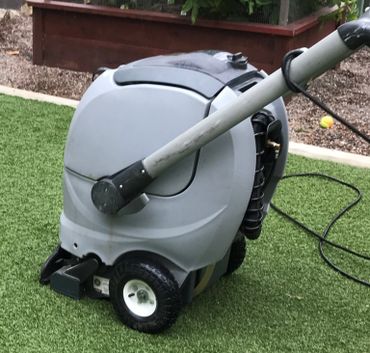
We specialize in removing sunscreen and lotion buildup from poolside synthetic turf. Our synthetic turf cleaning company in Glendale, California, uses enzyme-augmented surfactants and mechanical agitation to restore fiber resilience.
BriteTurf offers a full range of services, including artificial grass cleaning to maintain porosity and extend turf longevity.
Poolside Lotion Residue Contamination
Oil-based and emollient formulations deposit microparticulate films on synthetic fibers, degrading drainage permeability and fiber resilience through capillary action.
Lipophilic residues interact with infill like silica or crumb to make hydrophobic barriers that stop water getting in and speed up microbe growth.
Assessment Protocol
UV fluorescence or colorimetric analysis quantifies residue stratification across pile depth and subsurface channels, enabling targeted intervention.
Remediation Strategy
Surfactant-based solvents combined with protease and lipase enzymes break molecular bonds without fiber degradation. Additionally, a thorough deep debris removal process is essential to enhance the overall effectiveness of the cleaning strategy.
Rinse cycles must exceed residue particle suspension thresholds to prevent redeposition.
Verification Metrics
Post-treatment percolation testing, fiber tensile recovery measurement, and volatile organic compound reduction confirm restoration of drainage function and material integrity.
Sunscreen Residue Mitigation on Synthetic Turf
Lipid-based sunscreen emollients create hydrophobic microlayers that impede capillary water transport through infill substrates, compromising drainage efficiency.
Mineral formulations deposit inorganic particulates that mechanically abrade fibers or consolidate within the infill matrix.
Remediation methodology:
Enzymatic surfactants target lipophilic film bonds at fiber-emollient interfaces, breaking hydrophobic barriers without fiber degradation.
Sequential rinsing protocols prevent saponification byproducts from crystallizing and generating volatile organic compound emissions.
Verification parameters:
Permeability testing quantifies drainage rates post-treatment.
Surface uniformity assessment identifies residual buildup zones requiring retreatment.
This protocol restores hydrological function and extends turf longevity through science-based chemistry rather than abrasive methods.
Artificial Turf Maintenance: Veteran-Led
Veteran-led operational frameworks guide synthetic turf preservation through systematic surface preparation, microbial management, and fiber protection.
Core Technical Interventions:
Surface preparation eliminates organic debris and particulate matter that accelerates microbial colonization.
Calibrated mechanical removal prevents fiber matting while maintaining backing integrity.
Sanitation protocols employ non-corrosive antimicrobial agents compatible with polyethylene and polypropylene fiber compositions, addressing odor causation at bacterial source rather than masking symptoms.
Performance Outcomes:
Systematic maintenance extends turf lifespan by mitigating UV-induced polymer degradation and compaction from traffic loading.
Proper drainage maintenance prevents anaerobic conditions that generate odor and support pathogenic growth.
This evidence-based approach addresses California's climate variables—intense solar radiation and sporadic precipitation—through preventive intervention rather than reactive remediation.

Get Your Free Synthetic Turf Maintenance Estimate Today!
BriteTurf delivers evidence-based turf cleaning grounded in material science principles. Our methodology addresses organic debris accumulation, biofouling, and infill compaction—primary degradation vectors in synthetic turf systems.
Technical Service Scope:
-
Detritus extraction utilizing mechanical agitation
-
Antimicrobial treatment protocols reducing pathogenic colonization
-
Infill redistribution restoring drainage performance and cushioning properties
Current Offer:
$50 discount on initial maintenance assessment. Contact: 949-779-8873 | info@briteturf.com | contact us online here.
See why Glendale trusts us! Browse our Instagram gallery for stunning transformations, read Nextdoor community feedback, or explore our Yelp reviews, SoTellUs reviews, and Google reviews.
Glendale, California Events & Attractions Infrastructure
Glendale's public recreational ecosystem—encompassing amphitheaters, community parks, and designated animal relief zones—requires specialized surface maintenance aligned with California health codes and ADA accessibility standards.
Synthetic Field Systems: Infill composition, drainage optimization, and pathogenic load reduction through enzymatic sanitization protocols prevent bioaccumulation in high-traffic zones.
Playground Safety Surfacing: Impact attenuation standards (ASTM F1292) mandate periodic sanitization cycles targeting bacterial colonization in porous substrates.
Canine Facility Protocols: Designated potty areas require antimicrobial treatment schedules addressing parasitic transmission vectors and urine-derived nitrogen saturation.
Get Started
Fill out form below